Great Sandy Desert
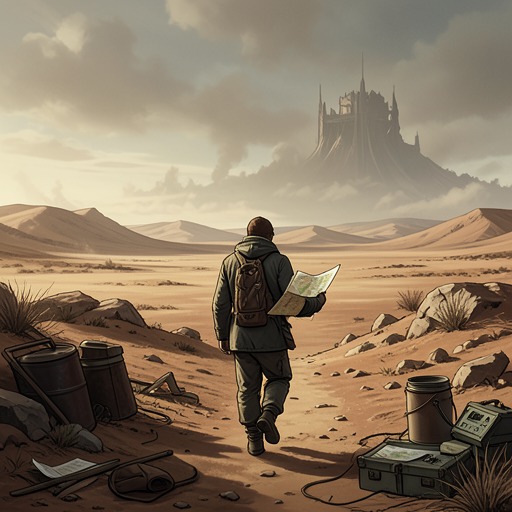
The Colour Out of SpaceThe Great Sandy Desert is the setting of the Australian expedition in which buried stonework, local traditions, and the narrator’s recurring memories converge. Its immense distances and shifting sands make the ruins difficult to read, while their apparent age unsettles the human scale of history. The expedition uncovers a substantial field of ancient masonry; its most consequential discovery, however, remains inseparable from the narrator’s uncertainty about what he saw.
Setting and First Reports
The site first enters the account through correspondence describing a desert location east of a gold field. A prospector reports finding dressed stones about 500 miles east of the field: roughly thirty or forty weathered blocks, some nearly buried, scattered within a circle about a quarter-mile across. The blocks, mostly sandstone and granite, carried deeply carved, curving lines. One appeared to be made of an unfamiliar cement or concrete. The correspondent judged their age immense, citing signs that the land had been submerged and later raised, and proposed an expedition to investigate them.
The same account relays local Indigenous traditions about marked stones, underground structures, and dangerous winds associated with passages descending beneath the earth. It also recounts the figure of Buddai, said to sleep underground until awakening to consume the world. These traditions reach the reader through the prospectors’ letters rather than through direct testimony from the people whose knowledge they describe. The proposed excavation likewise reflects the outsiders’ priorities: the correspondent offered to assemble miners for digging and said local people would not join because they feared the site.
The location was described as reachable from Pilbarra by motor tractor in about four days, with the De Grey River offered as an alternative route for transporting equipment. The reported site lay roughly 100 miles southeast of Joanna Spring. The correspondent supplied approximate coordinates and recommended a winter expedition because of the tropical climate and difficult desert conditions.
The Expedition and the Ruins
In 1935, Nathaniel Wingate Peaslee joined William Dyer, other members of the Miskatonic University party, and Robert B. F. Mackenzie, the Australian correspondent who helped prepare the journey. The party travelled from Boston by sea, then crossed the desert with tractors and excavation equipment. After fording a branch of the De Grey River on May 31, they entered the desolate country around the site. Peaslee’s unease was sharpened by dreams and apparent memories that seemed to anticipate the ruins, but the first physical evidence arrived when the party found half-buried blocks on June 3.
A month of digging yielded about 1,250 blocks at varying depths of wear. Many were carved megaliths with curved tops and bottoms; others were flatter, square, or octagonal, while several massive curved pieces suggested arches or vaulted construction. The deeper the excavators went, and the farther north and east they dug, the more fragments they found, though the blocks did not initially disclose a clear arrangement. Their scattering and erosion suggested immense age and repeated geological upheaval. William Dyer was struck by how old they seemed, and the expedition’s anthropologist, Tyler M. Freeborn, found symbols that appeared to connect with ancient Papuan and Polynesian traditions.
A plane helped the party search the surrounding sands for larger patterns. Wingate Peaslee repeatedly saw possible alignments from the air, but windblown sand obscured or altered them on later flights. These fleeting outlines intensified his sense of recognition without providing dependable archaeological confirmation: the landscape seemed to hint at a structure while withholding a stable plan.
A Buried Structure and Deep Time
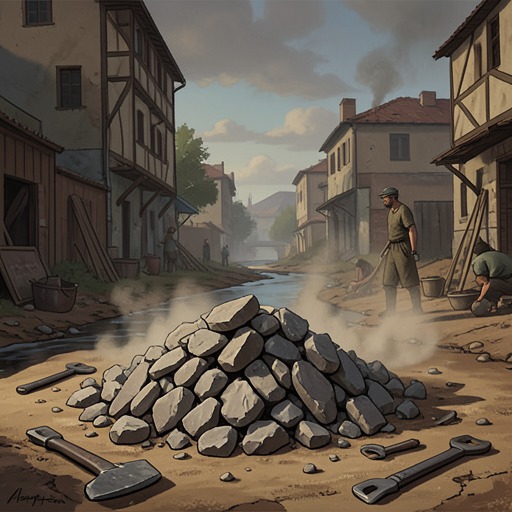
During a solitary night walk, Peaslee came upon a concentration of blocks exposed by the day’s wind. The roughly circular heap measured about forty feet across and stood between two and eight feet high. Under moonlight and torchlight, he recognized that the curved designs on separate stones belonged to a larger decorative scheme. For the first time, he believed he had found masonry still gathered in its original arrangement, although it had fallen and broken apart.
By climbing over the stones and clearing sand away by hand, Peaslee inferred the outline of a former corridor, which he imagined as about thirty feet tall, paved with octagonal blocks, and vaulted overhead. He also pictured adjoining rooms and a sloping passage descending farther underground. These details were not an intact architectural survey: they were his interpretation of fragmentary remains, made under the pressure of dreamlike recognition. The distinction matters because the site’s physical evidence and the narrator’s recovered impressions increasingly appear to confirm one another, while the account never fully separates observation from memory.
The ruins acquire a still larger historical meaning through the story’s account of the Great Race of Yith. That account describes a race that mastered the secrets of time and preserved knowledge of Earth’s past and future in vast libraries. It also recounts the arrival of the Great Race from Yith and its conquest of earlier, predatory beings, whose cities and subterranean domains belonged to an age long preceding humanity. The desert masonry is framed as a possible material trace of this immense prehuman history, not merely as an isolated archaeological curiosity.
The Metal Case and the Limits of Proof
Peaslee’s decisive claim concerns a book found in a metal case in the buried ruins. He reports that the book’s aged pages bore not unknown ancient signs but English words written in his own handwriting. The discovery would join the desert’s material past to the narrator’s disturbing memories of having lived as a captive mind of the Great Race. Yet he explicitly makes the revelation depend on whether his experience in the ruins was real.
That qualification governs the location’s final significance. Peaslee says he did not bring back the metal case, and the subterranean corridors have not been found. Without the case or independently verified passages, the desert offers no conclusive proof of his interpretation. Its stones remain material evidence of a very old and once-organized structure, but the connection to his memories and the book rests on his account alone. The Great Sandy Desert therefore functions both as an archaeological landscape and as the threshold where geological deep time, inherited traditions, and uncertain personal memory become difficult to distinguish.